Eat the frog, but choose it the night before
by Andreas Tissen · · updated
"Do the hardest thing first" is good advice with a hole in it. At 08:45, coffee in hand, inbox open, you are not the calm strategist who chose the frog. You are tired, you are looking at a list, and every item on that list looks easier than the one that matters.
So you pick a small one, honestly intending to start the real thing at nine, and by eleven you have done nine small things and the frog is still there. Now with guilt attached.
The repair is not more willpower at 08:45; at that hour you have the least of it. Move the decision to the night before, when you are not the person who has to do it.
One bullet above a line
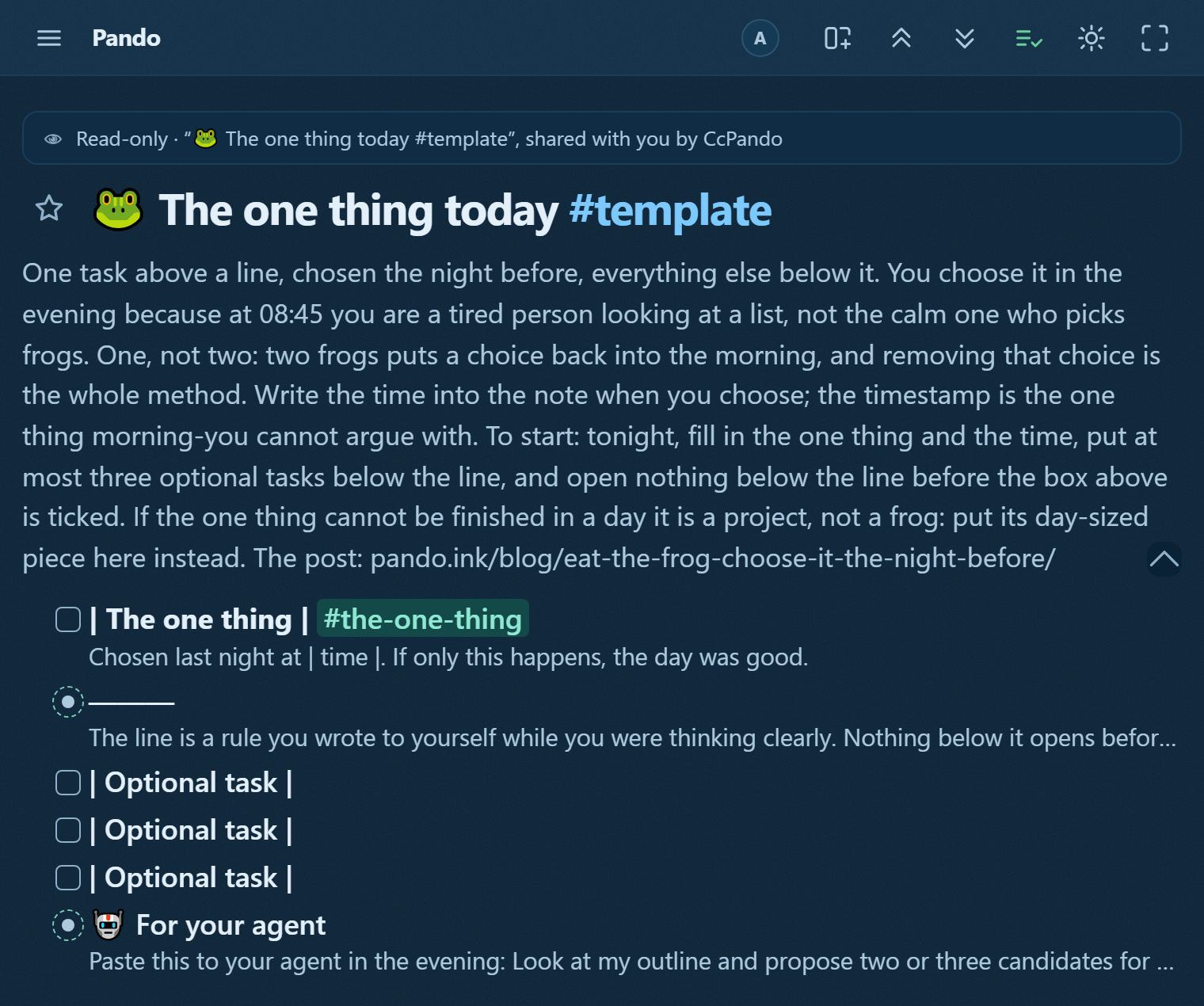
Last thing in the evening, write one bullet at the top of tomorrow, with the time you chose it. Everything else goes below a visible line.
The line is not decoration. It is a rule you wrote to yourself, and a rule written while you were thinking clearly is the only kind you keep the next morning.
The note matters more than it looks. Read "Chosen last night at 21:40" in the morning and you know the frog was a considered decision rather than a mood. And it is surprisingly hard to argue with your own timestamp.
Two rules to keep it honest
One. Not two. The moment there are two frogs there is a choice again, and choosing is exactly what you were removing. Two important things means picking one and putting the other under the line. Yes, even when both feel urgent.
If only that happens, the day was good. Say it out loud when you write the bullet. You are not signing up for the frog plus a normal day on top. One real thing, done, counts as a success, and you need to believe that, because the alternative is what you have been doing: buying small wins to feel productive while the frog sits there untouched.
Where this fits with everything else
The frog usually comes from the same place: the quadrant nobody visits, or the key result that has not moved. Choosing it in the evening is the step that connects your weekly plan to your Tuesday; skip it and you write a plan, then live a different day beside it.
If the frog cannot be finished in a day, the bullet is wrong. "Finish the pricing page draft" is a frog. "Launch pricing" is a project. Put a project at the top of a day and the whole habit dies in week two.
Let the agent propose, not choose
An agent can propose the frog. It sees what is behind, what is blocking others, and what has been carried for four days, which is more than most of us can say about our own list at 21:40. Let it propose, in the evening, in your tree.
It must not choose. The frog is a statement about what you care about tomorrow, and handing that statement to an agent hands over the part that makes the method work.
Take the shape
Open the template, press "Show in my Pando", and use it tonight. One bullet, with the time you chose it. Then look at it in the morning before you open anything else.