Pando vs Logseq, in the middle of the migration
by Andreas Tissen · · updated
You almost certainly chose Logseq for one reason: your notes are Markdown files on your own disk, and nobody can take them away.
I want to be straight about this before anything else. Pando does not do that. It is hosted. If files on your disk are the requirement, stop reading and keep Logseq, and the rest of this post is not for you.
TL;DR. Logseq 2.0 Beta, released 13 July 2026, is a database version. The thing most people chose Logseq for is the thing 2.0 changes. If you are going to move off plain files anyway, the question becomes what you get in return, and that is where this comparison is honest rather than flattering.
What actually happened
Read off the Logseq releases page on 22 September 2026:
- Desktop APP 2.0.1 (Beta Testing), 13 July 2026, marked Latest. The release note opens: "Logseq 2.0 Beta (DB version) is here!"
- The same note says: "As with any beta, please back up your important data before testing."
- The documentation says: "Big update: Logseq is splitting into two versions". One line carries on as what people now call Logseq OG; the other is 2.0.
- The last release in the stable 0.10.x line is 0.10.15, 1 December 2025.
So there are two products, the new one is a beta that tells you to back up first, and the old one has not had a numbered release in nine months.
None of that is a scandal. It is a hard migration, done in the open, by people who said what they were doing. But it puts a decision in front of you that you did not ask for, and it is worth making that decision deliberately.
At a glance
| Pando | Logseq | |
|---|---|---|
| Where your notes live | our server | your disk, in 0.10.x; a database in 2.0 |
| Works offline | yes, edits queue and drain | yes, entirely |
| Open source | no | yes |
| Agent access | hosted MCP server, OAuth, twelve tools | no first-party server I could find on 22 September 2026; community ones exist |
| Reachable with your laptop shut | yes | no |
| Phone | web app, keyboard bar under your thumb | mobile app |
| Free plan | 1,000 bullets, every feature, no card | the app is free |
| Paid | Pro is not for sale yet; at the 1,000-bullet limit you get three months of Pro, on us | Sync, and Logseq Pro has been discussed without a published price |
| Export | Markdown, OPML, spreadsheet, formatted text, whole-account backup | the files are the export, in 0.10.x |
Where they part
One is a graph, one is an outline. Logseq is a bidirectional-link graph with an outliner inside it. Pando is an outliner and nothing else: one document, bullets in bullets, zoom into any of them. If backlinks and queries are how you think, Pando will feel narrower, and it is. That is the trade and it is not subtle.
Your agent can reach a Pando outline with your laptop shut. Pando hosts an MCP server at a public URL, so Claude, Claude Code or ChatGPT connects over OAuth, gets one bullet of your outline as its persistent memory, and works in your whole outline, read and write or read only, while you are somewhere else. A local server cannot do that, because there is nothing running to talk to. Give your agent a memory walks through what that bullet actually holds after a week.
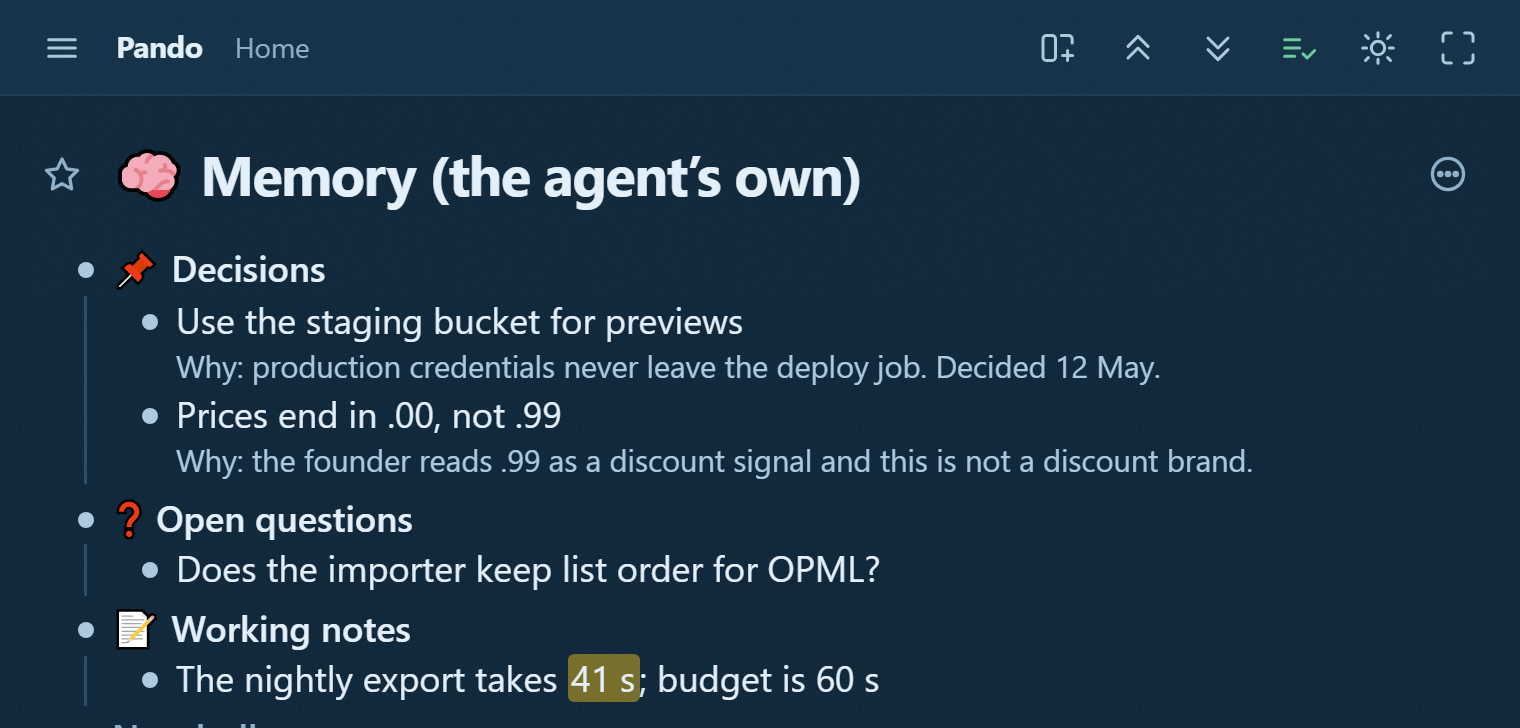
Nothing in Pando is metered per agent call. The tokens are paid for by your own Claude or ChatGPT subscription, so there is nothing for us to resell, and agent access is on the free plan and stays there.
What Logseq has that Pando does not
It is open source and your data is yours in the strongest sense. If Logseq stopped tomorrow, somebody forks it and your files are already on your disk. Nothing forks a hosted service. That is a real difference and it is the reason to stay.
Queries and backlinks. Pando has search, tags, mirrors and dates, and it does not have a query language.
It costs nothing, at any size. Pando is free for 1,000 bullets, and Pro, which lifts the limit, is not for sale yet.
The honest answer to "what if you disappear"
Since files-on-disk is the thing you would be giving up, here is what replaces it, said as precisely as I can.
Everything in Pando exports at any time, without asking anybody: Markdown, OPML, a spreadsheet, formatted text, or a backup of the whole account in one file. None of those formats needs Pando to be readable.
And that claim is tested rather than asserted. Every run of our own test suite exports a whole account through the public door, imports it into a different, empty account, exports that one, and compares the two files byte for byte. The reading on 22 September 2026 was 1,267 bytes of OPML and 567 bytes of Markdown, out of two accounts, identical. The test prints those numbers, so it is a figure you could check rather than a promise you have to take.
It is still not the same as a file on your disk. It is what a hosted product can honestly offer instead, and I would rather name the gap than paper over it.
Moving in, if you decide to
Logseq exports Markdown and OPML, and Pando imports both. Drop the file into the app and the tree comes over with its shape, its notes, its checkboxes and its umlauts. Import is one mutation, so if it lands wrong, one undo takes the whole file back out. Moving in has the whole list of what each file format carries and what it drops.
What does not come over: queries, and anything that depends on the graph rather than on the tree.
If you are only here for the agent
You do not have to move at all. Keep Logseq for the vault and give Pando the branch your agent works in. They are not exclusive, and a hosted outline your agent can reach is a different job from a local graph you think in.