Pando vs Notion, when your Claude works in both
by Andreas Tissen ·
In August this page said the difference between Notion and Pando was the AI. Notion had its own assistant; Pando had your Claude and ChatGPT. That was wrong even then. Notion has run its own hosted MCP server since at least July 2025, Claude's connector directory lists it as Anthropic verified, and ChatGPT sets it up as the Notion app. Your agent works in both.
So this is the comparison again, checked on 23 September 2026 against Notion's own documentation and against Pando's code.
TL;DR. Pick Notion for a team workspace: wikis, databases, permissions per teamspace, page history, and far more agent tools. Pick Pando to think in an outline, where indenting is the structure. On agent access the two are closer than you might think, and four differences matter most.
At a glance
| Pando | Notion | |
|---|---|---|
| Shape | one tree; indenting is the structure | pages you can nest, and databases on top. |
| MCP server | hosted, at pando.ink/mcp, 12 tools | hosted, at mcp.notion.com/mcp, 37 tools. |
| What a Claude or ChatGPT connection reaches | the whole outline, to read and write, or to read only, until you hold it to one bullet | everything you can access in the workspace you pick, says Notion. |
| Held to one branch or page | yes, with one press after you connect, for a Claude or ChatGPT connection and for an agent you create inside Pando | not through the hosted MCP server; a Claude agent inside Notion can be. |
| How long a connection lasts | until you revoke it | up to 180 days, or until 30 idle days; the access token renews itself. |
| Your own Claude on the free plan | all of it, and no card | the MCP server works on every plan; some search filters need Business. |
Where they part
One is an outline and one is a workspace. Notion nests too: Tab indents a block under the one above it, and any line can become a page. What Notion adds on top is the database, with its properties and views, and that is where most of its structure lives. Notion's agent can now build one from a sentence. In an outline, indenting is all the structure there is. When content does need rows and columns, a Pando bullet shows its children as a table or a board, and turns back.
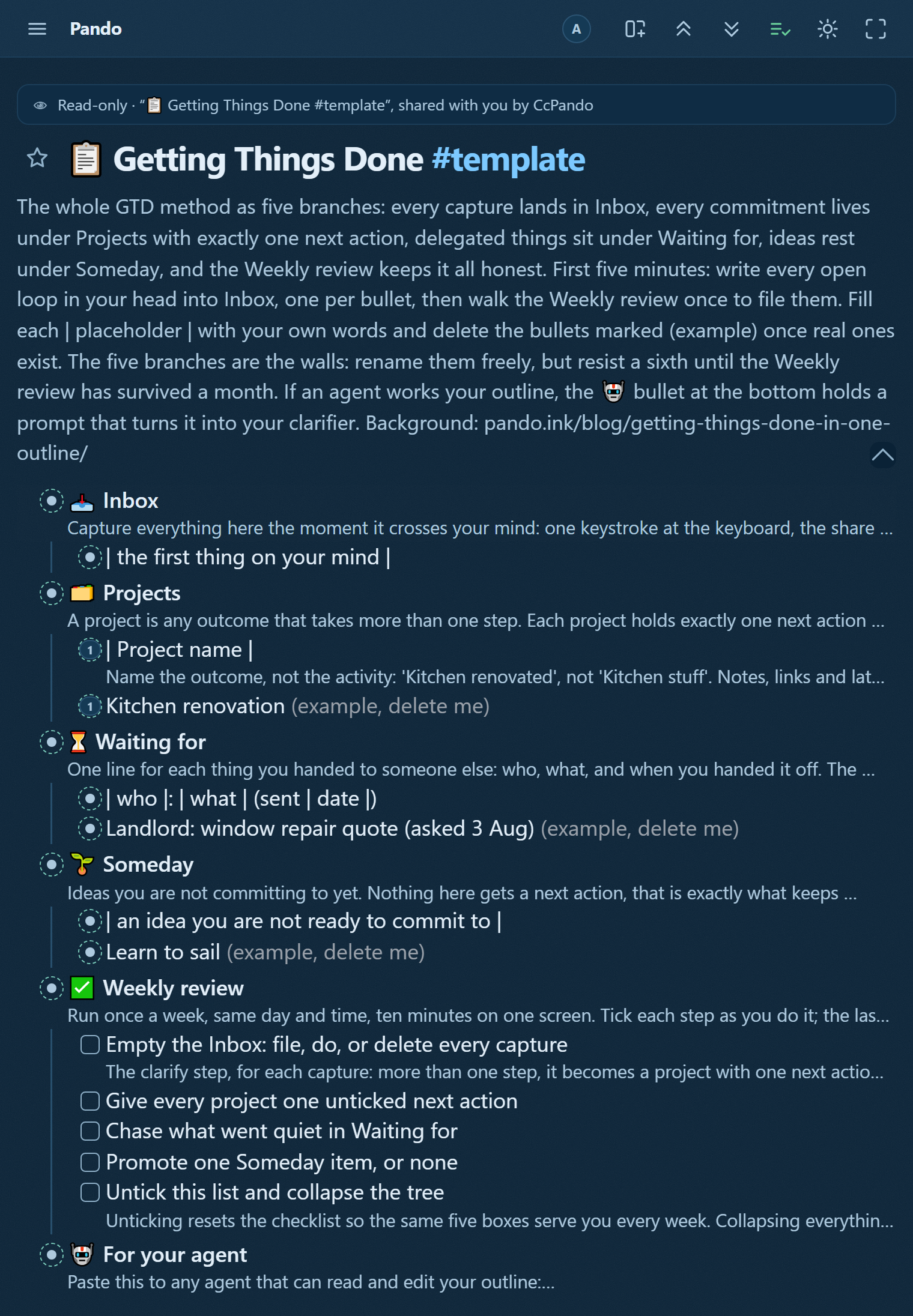
Both are real ways to work. The second suits notes whose shape you do not know yet.
What actually differs for your agent
Both servers are hosted, both use OAuth, and both reach more than you might expect. Notion's help centre says "MCP tools act with your full Notion permissions". Pando's consent page says of its read-write option: "It can read every bullet, add, change, move and delete." Neither consent page lets you pick one page or one branch. OpenAI's help adds that a ChatGPT connection to Notion depends on "the workspace and content authorized for the app". Pando can hold a claude.ai or ChatGPT connection to one bullet afterwards, with one press in the app; Notion's hosted server cannot. What else differs is this.
A read-only connection. Pando's consent page offers "Read your outline only". The server then refuses every write except in a bullet the agent is given to remember in, and the box that gives it one can be unticked on the same page. Notion's MCP server offers a single OAuth scope, named "default", so a Claude or ChatGPT connection to it cannot be made read-only. Notion's own answer to a bad write is page history: 7 days on Free, 30 on Plus, 90 on Business, and unlimited on Enterprise.
An MCP key that needs no browser. A key you make inside Pando, under Agents and API keys, works as a Bearer header from Claude Code or a script. The key of an agent you create there can be held to one branch: untick both boxes on the New agent form, open that branch, then tap the agent's row under Your agents and press "Let it reach only", the button that names the bullet you are in. The same press holds a Claude or ChatGPT connection. Notion's hosted MCP server answers "Not yet" to non-interactive use. A script can still use Notion's REST API with an internal connection's token, which sees only the pages shared with it and can be limited to reading. The difference is MCP: a Pando key gives Claude Code the tools rather than raw API calls. Neither helps ChatGPT, and claude.ai can send a Pando key only through a custom connector's Request headers, a beta Anthropic offers to a limited set of organizations. An organization administrator enters it there, and one key then serves every member.
How often you sign in again. A Pando connection lasts until you revoke it under Agents and API keys. Notion's access tokens last about eight hours and renew by themselves, and the sign-in ends after 180 days, or 30 idle days. Notion's own guidance: "Treat periodic reconnection as expected, not exceptional." That is a trade-off, not only a win. A credential that lasts until revoked is one you have to remember to revoke.
Reading only what changed. Pando's changes tool returns the edits since the agent last looked. On a 1,515-bullet outline, five changed bullets came back in 1,060 bytes against 962,608 for reading the same tree again; over a real week with 731 changed bullets, the feed was 5.4 times smaller than a full re-read and only 1.1 times smaller than a re-read in outline mode. Both numbers are Pando's own. On Notion's Business and Enterprise plans, notion-search can filter by last-edited date, which finds the pages that changed but not what changed in them. The reasoning is in Never re-read what you have already read.
Where Notion wins
Said plainly, because it is most of the list.
- Distribution. Notion is in Claude's directory and is a listed ChatGPT app. Pando is added as a custom connector, and in ChatGPT that can mean turning on developer mode.
- Tool breadth. 37 tools against 12: databases and views, SQL across data sources, AI search across the apps connected to Notion, file uploads, comments, meeting notes and Custom Agent sessions. Pando is far behind here.
- Governance. A client allowlist, per-member revocation through an admin API, and audit events for pages an external AI read. All of it is Enterprise.
- Agents that live inside Notion, shared page by page. Notion's help for Claude agents in Notion: "Claude agents can only see what you share with them." Those are in beta; Custom Agents are not, and can run on Claude models. Both come with Business and Enterprise, and both cost Notion credits. None of this is your own Claude connected over MCP.
- A team workspace. Teamspaces with their own permissions, rollups, embeds from over 1,900 domains, and public pages with custom domains.
- Room for one person. Notion's free plan has no block limit for an individual. Pando's free plan holds 1,000 bullets.
What it costs
Notion lists Plus at USD 10 (EUR 9.50) and Business at USD 20 (EUR 19.50) per member per month, billed yearly. Notion AI is on Business and Enterprise, and Free and Plus get a limited number of AI responses to try it. Custom Agents and Claude agents in Notion cost Notion credits on top, at USD 10 per 1,000. Connecting Notion's MCP server needs no particular plan, and some tools and filters need Business or Enterprise.
Pando is free for 1,000 bullets with every feature, agents included, and no card. The tokens your agent spends are paid by your own Claude or ChatGPT plan. Pro is not for sale yet, and at the limit you get three months of it on us.
Who each is for
- Stay on Notion if the value you get is a shared workspace the team relies on, or if you want the widest set of agent tools. Your Claude already works there.
- Try Pando if you want an outline to think in, an agent held to read only or to one bullet, and an agent that reads only what changed.
The cheap way to find out is to connect your agent to both for a week. Pando takes about two minutes on the connect page. A Notion export is a zip; unpack it and bring pages in as Markdown, as Moving in describes.