Pando vs Tana: two answers to the same bet
by Andreas Tissen · · updated
If you want a knowledge base with typed nodes and a built-in AI staff, Tana is the more ambitious product, and it is good. That is the concession this page opens on, because it is where the comparison matters most: of every product on these pages, only Tana takes the same bet Pando takes, that an outline stops being a private notebook and becomes a place where AI works. Tana is not coasting on a decade of polish and it is not in maintenance mode. It ships, it has a devoted power-user community, and it says "agentic era" out loud.
TL;DR. Two products, one bet. Tana sells you the AI that runs on your notes: transcription, an assistant reading the graph, supertags that turn a bullet into a typed record. Pando houses the AI you already pay for (Claude, ChatGPT, Claude Code) with an assigned memory branch and a lock against agents on any bullet. Pick Tana if you want an AI-operated knowledge OS with meetings inside the graph; pick Pando if you want your existing agent to work in your outline and never rent an AI twice.
At a glance
| Pando | Tana | |
|---|---|---|
| Whose AI works here | Your Claude or ChatGPT, connected over MCP | Tana's own assistant, metered |
| Agent memory | A branch you assign; it survives every session | Tana's assistant remembers within the graph |
| Grant model | The whole outline, read and write or read only, or one bullet you pick afterwards; a protected bullet refuses every agent | Workspace access |
| Typed nodes / schema | Tags, layouts and tables; no schema system | Supertags turn a bullet into a typed record |
| Meetings inside the graph | Not built in | Transcription, voice capture, calendar |
| Import / export | Markdown and OPML | Its own export |
What Tana gets right
- Supertags. Add fields to a tag and a bullet becomes a record, a workspace becomes a database that grew instead of being designed. Pando has tags, layouts and tables, and no schema system; if typed nodes are the point for you, that argument ends here, in Tana's favor.
- Built-in AI. Meeting transcription, voice capture, calendar integrations, an assistant that reads the graph. It arrives configured; you bring nothing.
- An API and MCP. Tana opened its workspace to outside tools too. Your agent can read structured notes there and write structure back. That matters here. Pando is built around exactly that access.
Whose AI is it
Tana's assistant is Tana's product. You buy it from them, metered: the free plan holds 50 AI queries and five transcribed meetings a month, and lifting the meter costs 20 dollars a month early-bird, 30 after, or 80 for the Max tier, as their pricing page stands in August 2026. The AI improves when Tana improves it, not when yours does.
Pando sells no AI at all. The agent in your outline is the one you already pay for and already trust: Claude, ChatGPT, Claude Code, connected over MCP in two minutes. It remembers in a branch you assign, works in your whole outline at the level you chose, appears by name, and every key is revocable on one page. When your model gets smarter, so does the agent in your tree, and Pando meters nothing on the way.
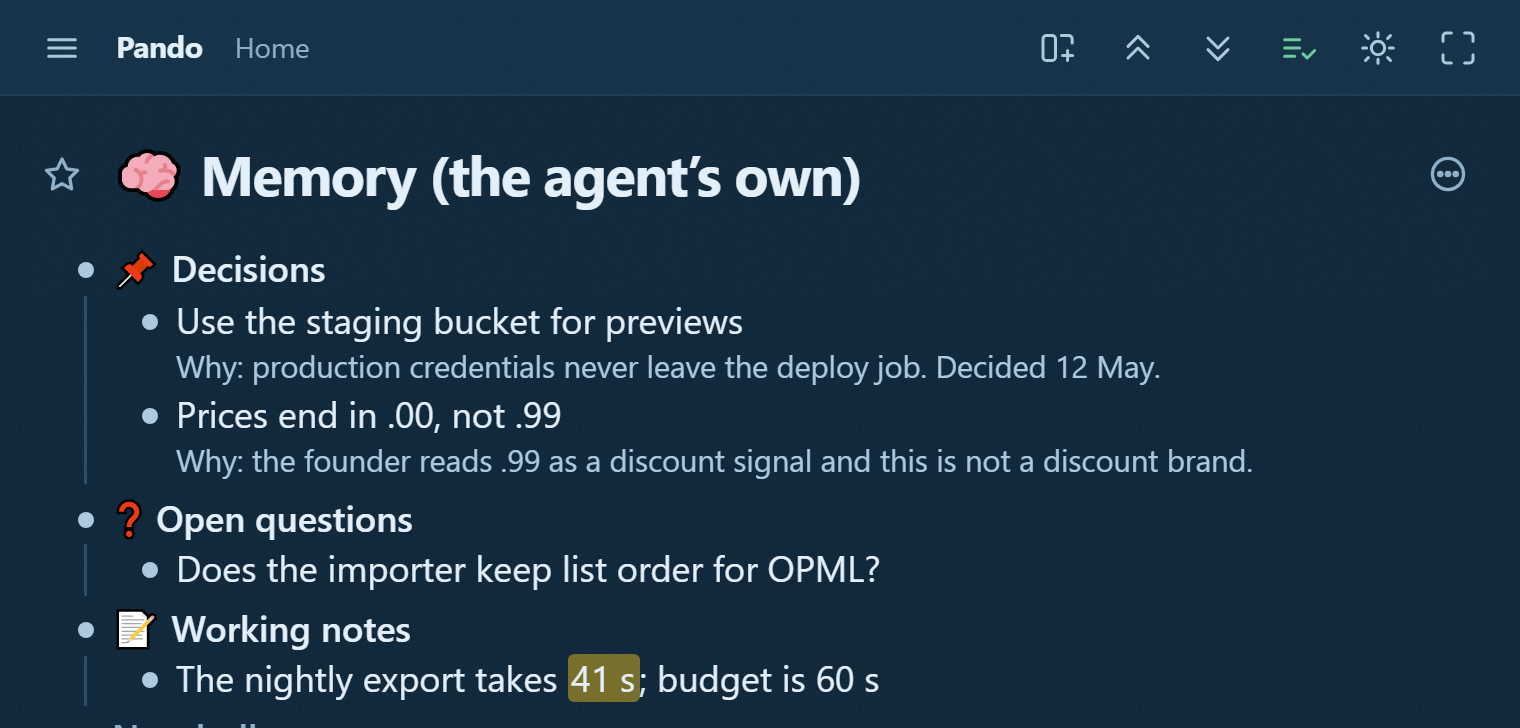
The grant is where the two are closest. What you approve in Pando is your whole outline, the same kind of reach as Tana's workspace access. Three things differ. You can make it read only, you can hold it to one bullet afterwards, and a bullet you protect refuses every agent. What the agent does with that reach is the inbox pattern. It works, writes what only you can do into your tree as checkboxes, and waits; you tick, it continues. For that pattern you need an agent that is a resident with an address, not a feature behind a credit meter.
The honest caveat
If your work happens in meetings, Tana transcribing them into the graph is worth real money, and nothing in Pando replaces it. And supertags are not a gimmick; a schema that emerges from use is a genuinely great idea. Tana is the right choice for a person who wants an AI-operated knowledge OS and is happy to rent the AI with it.
Who each is for
- Pick Tana if your work happens in meetings, a schema that emerges from use is a feature you would pay for, and you want an assistant Tana keeps improving as part of the product.
- Pick Pando if you already work with an agent (Claude, ChatGPT, Claude Code) and you want it to live inside your outline with a memory branch and a lock against agents on any bullet, without renting a second AI on top of the one you already pay for.
Trying it costs a morning
Take one project, not your life. Start one branch for your agent from the template gallery, or connect it to a blank tree and watch the inbox pattern fill. The way out is one export, Markdown or OPML, so you risk nothing by trying. Both products make the same bet; the question is only who your AI works for.