The Checklist Manifesto in an outline
by Andreas Tissen · · updated
A piece of paper cut major surgical complications by more than a third. In the study hospitals it cut deaths by nearly half. A sheet of paper. Not a device, not a drug: a list of steps everybody in the room already knew.
That is the uncomfortable finding in Atul Gawande's Checklist Manifesto. Experts do not fail from ignorance. They fail from skipping steps they know cold, under load, at 4 p.m., with a phone ringing. Your deploys fail exactly like that. So do your handovers, and so does your week, which is why the pattern transfers from the operating room to your work without needing a single adjustment.
Gawande leaves you three working rules. Most digital checklist tools quietly make you break the third.
The three rules
A checklist has a pause point. You run it at a named moment: before the incision, before you press deploy. A list with no moment attached never gets run.
It is short. Five to nine killer items, the steps that hurt when skipped, and nothing else. Gawande's teams threw out more items than they kept. That ratio is the point.
The master stays clean. You run a copy, always a copy. Tick a checklist directly and it is used up: next run you either untick everything and lose the record, or you trust a list that arrives half-checked.
Masters above, runs below
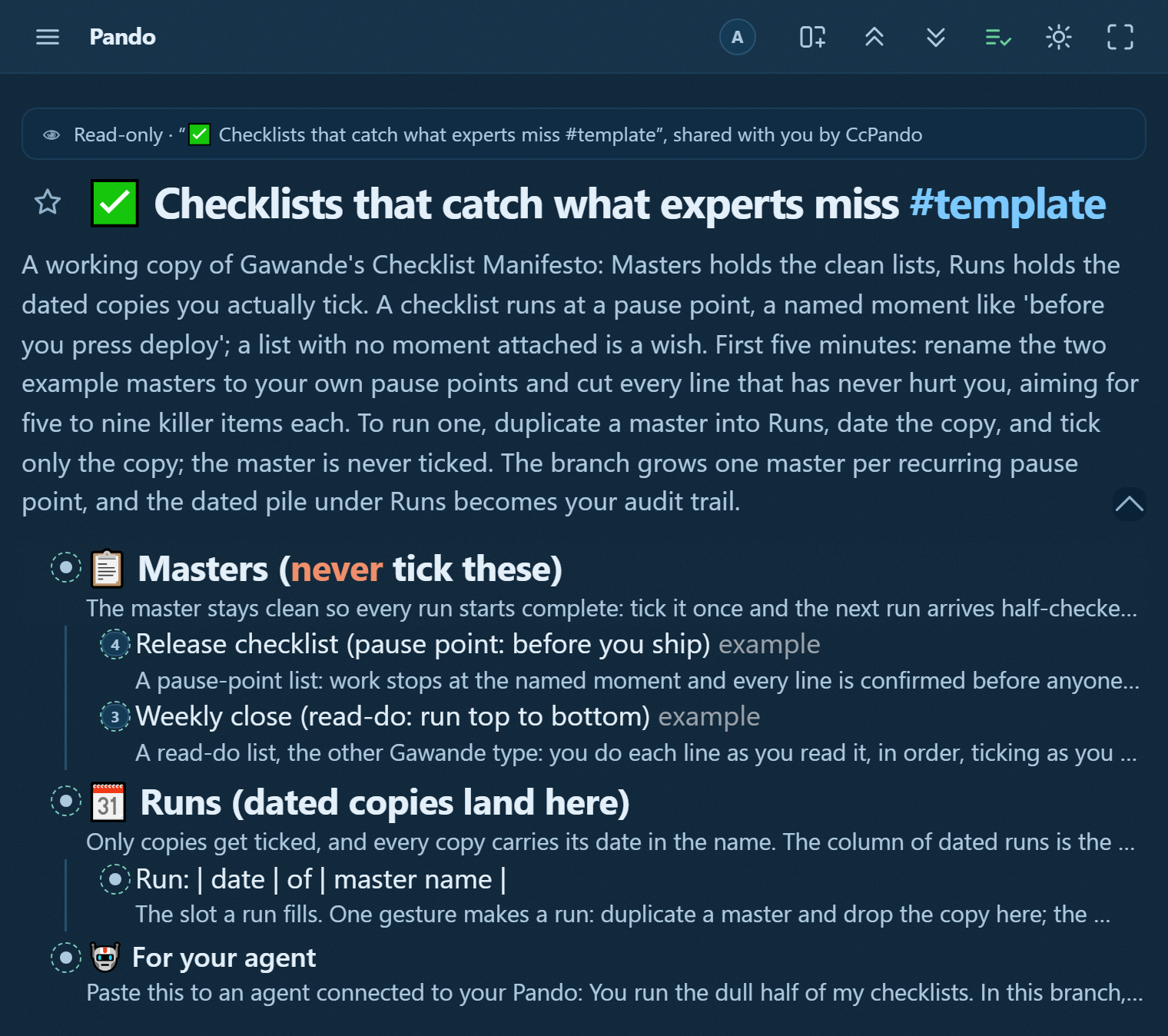
Two folders are the whole discipline, and the picture shows them mid-use. MASTERS holds the clean lists, each named after its pause point. When the moment comes, you duplicate the master, drag the copy under RUNS, and tick the copy. The date chip on the run is your audit trail. When did the team start skipping the rollback line? What did it cost?
A checklist here is just bullets with checkboxes, so editing costs nothing, and a checklist that is cheap to edit keeps matching the real work instead of drifting away from it. Gawande's teams re-cut their lists every few months. Your review takes one glance at RUNS. An item ticked without thought in every single run gets deleted. A failure no line would have caught becomes a line.
The dull half goes to the agent
The discipline has a boring half. Duplicate the master at the pause point. Date it. File it under RUNS. Nag about unticked killer items. An agent connected to the same tree does all of that reliably, at any hour, without being asked twice. The judgement half stays yours: what belongs on the list, and what you learned from the last failure.
Take both checklists
Open the checklist template, press "Show in my Pando", and rename the two masters to your own pause points. Then cut every line that never hurt you.