Time-blocking against a list that lies
by Andreas Tissen · · updated
Look at today's list. Count the items. Now count the hours you actually have after the meetings, the interruptions and lunch. If those two numbers are not close, the list is lying to you, and it lies in the same direction every day.
This is not weak planning. It is structural: a to-do list is a set, and a set has no length. Nowhere in the format is there room for "that is more than fits".
Time-blocking is the correction. Every task gets a place in the day, and the day has a fixed size, so overcommitment stops being invisible.
You do not need a calendar app for this
The version that works is smaller than people expect. Give each block a bullet, put the tasks under it, and put a date on the parent.
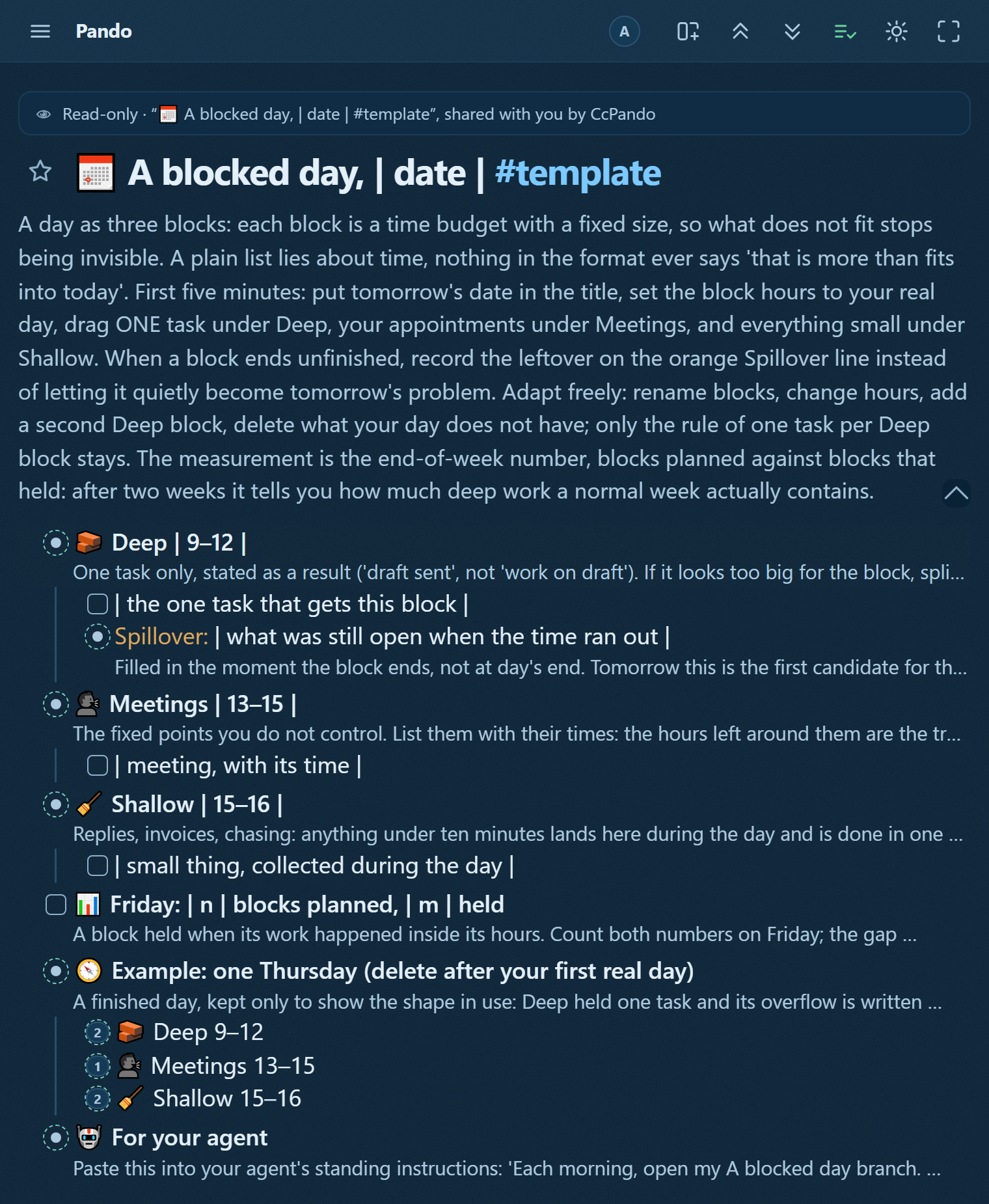
Three blocks, not twelve. The point is not to schedule every minute; it is to make the SIZE of the day visible. Three named blocks are enough. Twelve would just be a list with times bolted on.
The two things that make it survive contact
Spillover has a name. When the two hours end and the draft is not done, it does not vanish and it does not silently become tomorrow's problem. You move it into another block, where you can see it. If a normal Thursday counts as a failure, you abandon the method by Friday.
Shallow work gets its own block. Replies, invoices, chasing. Most people scatter these through the day, which is how you get one hour of work out of a day with four hours of capacity. One container, one pass, done.
Why an outline is the honest place for this
Because tasks already live here, blocking is a move rather than a re-entry. You drag today's real work under a block, and what you did not drag is exactly what you did not have room for. That leftover is the finding, and in a calendar app it is invisible because it never got typed there at all.
And when the day ends, the blocks stay as a record of what the day held. After two weeks you can answer the question everybody guesses at: how many hours of deep work does a normal week actually contain? Mine is smaller than I would have said, which is the useful kind of unpleasant.
The agent's part
Two things it can do without judgement calls: carry unfinished items to tomorrow's blocks in the morning, keeping their spillover mark, and tell you the number at the end of the week: how many blocks you planned, how many survived. Planning the day is yours; counting is not.
Take the day
Open the template, press "Show in my Pando", and make three blocks tomorrow with real work in them. At the end of the day, look at what did not fit. Three days is enough to see whether your list was lying, and by how much.