Two agents, one tree: memory shared, work not
by Andreas Tissen · · updated
One agent with a memory is a solved problem. Run a second one and something new breaks. They disagree, and neither knows it.
Your research agent decides the pricing page ships in September. Your coding agent, in a different conversation, is building against October. Both are confident, both wrote it down, and nobody ever puts the two notes side by side. You find out in three weeks, from a calendar.
This is not a memory problem. Both remembered perfectly. It is an agreement problem, and agreement needs a place, not a bigger context.
A branch each and one they share
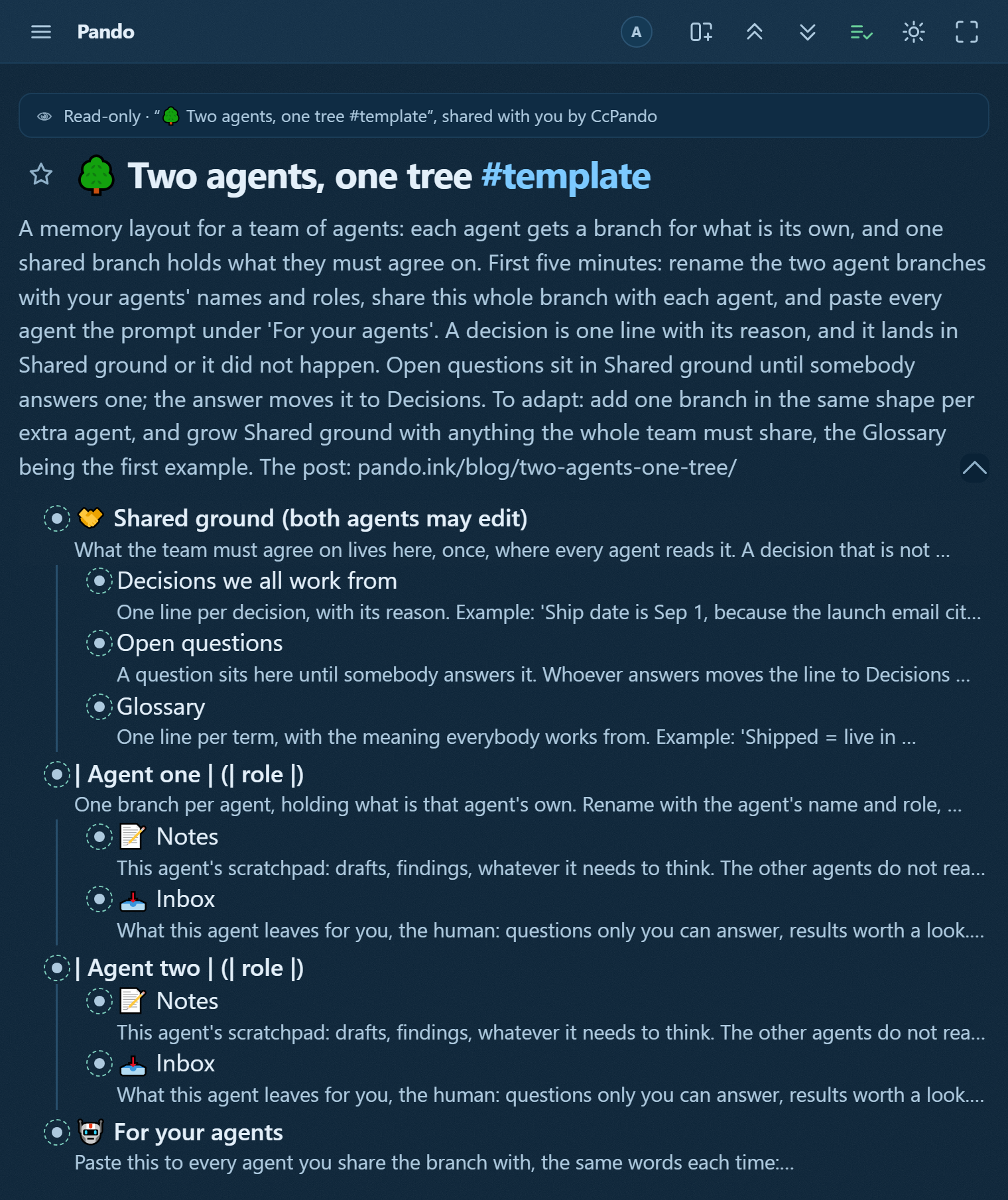
The layout that works is two rules:
What is mine is mine. Each agent gets its own branch: working notes, its inbox to you, whatever it needs to think. Neither needs to read the other's scratchpad, so nobody drowns in it. Two agents can still each open the other's. A connector starts with your whole outline, and an agent held to one bullet reaches that bullet and everything under it, which here has to be the whole team branch.
What we must agree on lives once. One shared branch, both may edit, holding decisions and open questions. A decision is one line with its reason. An open question sits there until somebody answers it and moves it to Decisions.
The picture is the whole architecture. There is no coordination protocol, because the tree IS the protocol.
Why this beats making them talk to each other
The instinct is to have agents message each other. That reproduces the original problem one layer up: two conversations, two memories, no shared state, and now also a transcript nobody reads.
Shared state has three properties that messages lack. It is checkable: you can look at Decisions and see what your team believes. It is durable: a new agent added in October reads the same lines and starts agreeing. And it is correctable: when the September date is wrong, you fix one line and every agent inherits the fix, with no broadcast.
The rule you give both agents
One line for both of them: "Never silently rewrite a decision somebody else wrote. Add your own line, or move the old one to Open questions with what changed."
Without that line, shared ground turns into a place where whoever writes last wins, which is how shared documents usually die.
What you get to see
The quiet benefit is that disagreements become visible before they cost anything: two agents with different beliefs produce two lines in Decisions that contradict, in the same view, where you will see them. That is not a failure of the setup; it is the setup working.
Take the team layout
Open the template, press "Show in my Pando", point each agent at the whole branch (a connector on your whole outline already reads it; for an agent held to one bullet, make this the bullet it remembers in), and tell both the same sentence: "Read Shared ground first. Keep your own notes in your own branch. Never rewrite somebody else's decision."