Eight deploys from a sofa, phone only
by Andreas Tissen · · updated
Eight changes went live on this product in one session while I was out of the house. I typed one line to start it, read no transcript, scrolled nothing, and lost nothing.
That is not a story about a clever agent. It is a story about where the work was written down.
A channel is not a state
Chat is a channel. It carries messages in an order, and the only way to know what it says is to read it from somewhere to somewhere. It has no current value. To find out what is waiting on you, you scroll up until you have read enough.
A list is state. It has a value right now, you read it in one glance, and reading it twice costs the same as reading it once.
Every durable coordination system humans built runs on state, not channel. The flight strip on a controller's desk. The punch list on a building site. The whiteboard in an operating theatre with the count of instruments on it. None of them is a transcript of who said what. Each is the current answer, kept in one place, changed in place.
Agentic coding today lives almost entirely in a channel. The plan, the blockers, the decisions and the outcome all arrive as messages, in order, mixed with the reasoning that produced them. It works while you are sitting there watching it. It falls apart the moment you are not.
Where it dies
You are away for two hours. The agent hit something only you can do: activate the payment account, send the register facts, approve a migration. It asks. The ask is message 47.
You come back. To find out what is waiting on you, you have to read from message 30. To find out what is done, you read further. To answer, you have to reconstruct which of the three things you already did last night. Meanwhile the agent, which cannot see your memory either, asks again.
The asking has become the work.
Now do that on a phone. A transcript on a 411 pixel screen is the worst possible reading surface: no overview, no jumping, no glance. This is why "agentic development on the go" mostly does not happen. Not because the models are weak, but because the only way to read a channel is to scroll through it.
Two branches, one tree
Put both directions of the work in a shared outline instead, and give each direction a branch.
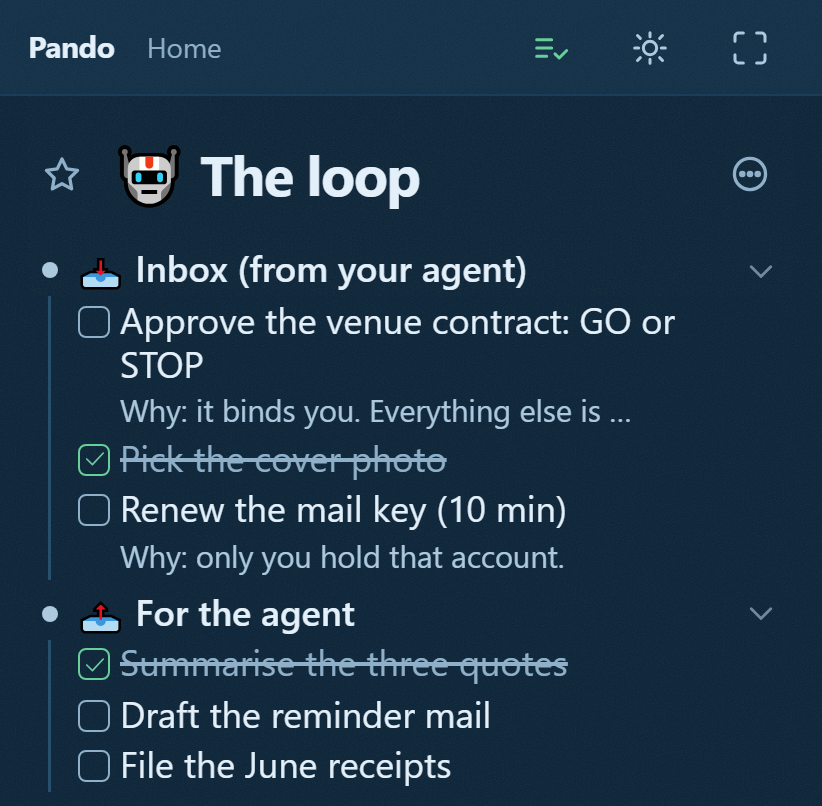
Inbox (from your agent). The agent writes what it is blocked on, as a checkbox task. The line says what and how long. The children are the steps. The note says why, so you can refuse with context instead of trust.
For the agent. You write what you want next, as a checkbox task, in the same shape. One line each. No preamble, no "hey can you also".
Both sides read the same branch. The tick is the protocol. A task is open until somebody ticks it, and it never drifts out of sight the way message 47 did, because a branch is not a feed.
What exactly this buys you
Nothing gets dropped. A request leaves the list when it is ticked, not when it ages. Six requests in one morning are six lines you can count. In a chat, six requests are six sentences among four hundred, and the count is whatever anybody remembers.
No re-reading. You open the branch and you are looking at the current state. Not what was true at message 30 plus everything since.
It is genuinely asynchronous. The agent does not need you present to make progress: it queues the human step and takes the next thing off "For the agent". You do not need it present either. Neither side is ever blocked on the other being awake.
It survives the session ending. Close the tab, lose the connection, come back tomorrow with a different model in front of you. The branch is still the branch. The transcript was disposable all along.
Why it is better on a phone
A phone is a bad place to read a conversation and a very good place to read a list and tap one box.
Look at the picture again. Six tasks, two directions, three ticks, one screen, no scrolling. The most common thing you do on the go is not writing: it is deciding, approving, and answering "is this done?" All three of those are one tap against a list, and all three are five minutes of scrolling against a channel.
This works on the desktop too, and on the desktop it is merely tidy. On a phone it is the difference between working and waiting until you are back at the machine.
Set it up
Two bullets and one sentence to your agent:
When you are blocked on something only I can do, write it as a checkbox
task under "Inbox (from your agent)": the line says what and how long,
children are the steps, the note says why. Read "For the agent" for what I
want next, and tick a task there when it is shipped. I tick yours; you tick
mine.
Agents connected through Pando's MCP door with write access read and write those branches directly, so there is no integration to build and no second app to keep in sync.
Open the inbox template, press "Show in my Pando", and the agent's half stands in your tree with two example tasks showing the shape. Add one bullet beside it called "For the agent". That is the entire setup, and the second direction is the half most people skip.
Part two is about the other half of working this way: what the agent should write in those lines, so that five bullets can hold eight hours of work with nothing hidden.