BLUF for agents: escalate detail, do not dump it
by Andreas Tissen · · updated
The written record of one working session on this product is 11,222 words. The top layer of the same report is five lines and 60 words. Nothing was left out of the short version. It is sitting one tap underneath it.
That is the whole trick, and it is the difference between an agent you can supervise from a phone and one you stop reading.
Agents do not write too much by accident
An agent that just did four hours of work has a real problem: it does not know where you will stop reading. So it hedges by including everything. You get the reasoning, the measurements, the alternatives considered, the caveats, in one long linear block, because prose has only one length and the writer has to pick it.
Pick short and you cannot check the work. Pick long and nobody reads it, which is worse than short, because now the detail exists AND is not read, and both sides believe it was communicated.
The half the military solved
The military solved half of this decades ago. BLUF: Bottom Line Up Front. The first sentence of the message is the conclusion and the required action. Everything else is support, and support goes below. Journalists call their version the inverted pyramid: the lede carries the story, and each paragraph after it matters less, so an editor can cut from the bottom without cutting the story.
Both exist for the same reason. The reader stops at an unknown point. So value has to be front-loaded rather than built up to.
With BLUF the order is right and the volume is untouched. A BLUF report is still one document at one level of detail, and it is still read top to bottom by someone who wanted one number. The support paragraphs are still there, in the way, for every reader who did not need them.
Escalation is BLUF with layers
In prose, cutting detail means losing it. In an outline, cutting detail means folding it.
An outline is not a document with headings. It is a stack of layers where every layer is a complete answer, and each layer is the summary of the one below it. You read down until you have what you came for, and you stop. What you did not read is not missing. It is closed.
Here is a real session report, top layer only, on a phone:
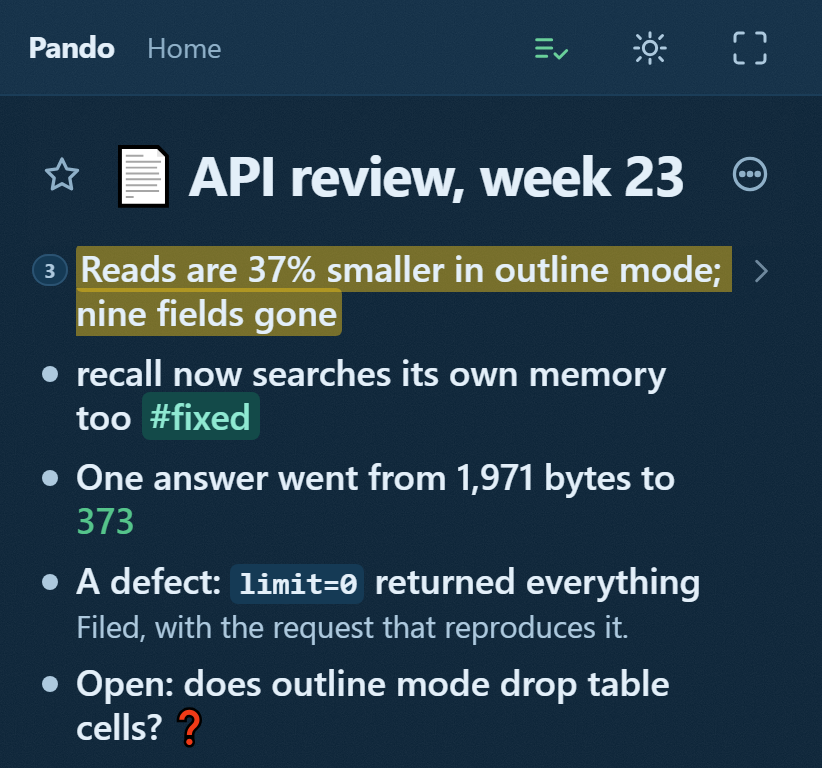
Five lines. Four hours of work. Each line is a claim with its number in it, and each carries a count of what is folded underneath.
Now the line you stopped on, opened:
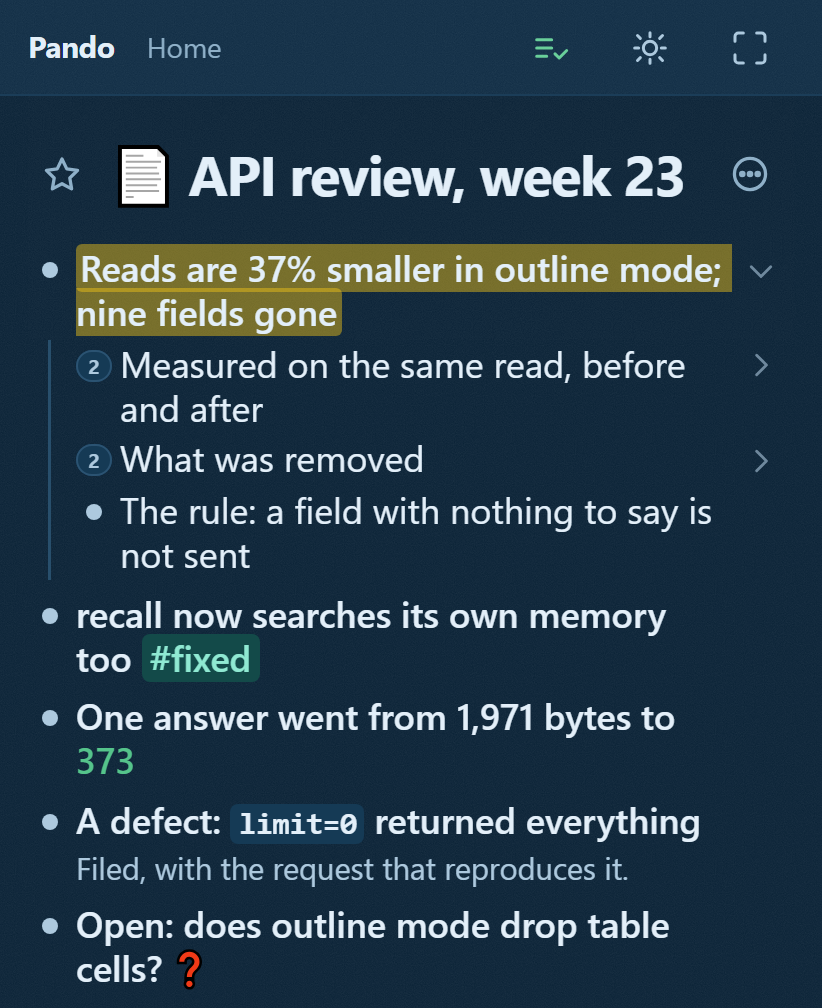
One tap. The evidence is there: what was measured, before and after, what was removed, and the rule that came out of it. Tap once more and you get the raw byte counts. The other four findings did not move and did not cost you anything.
The one rule
There is exactly one rule, and if you break it the whole thing collapses back into a document with indentation:
**Every line is true and complete on its own, and its children are only the
evidence for it.**
Which means, concretely:
- A parent line is never a label. "Performance work" is a label; "Reads are 37% smaller" is a finding. If a line does not survive being read alone, it is a folder and it belongs in the trash.
- A child never repeats its parent. It supports it. If you find yourself reading the same sentence one level down, the level is decoration.
- The numbers live at the bottom, not the top. The top says 37%; the bottom says 48,427 to 30,263 bytes on 125 bullets at depth 3. Both are needed. They are not needed at the same time.
- Bad news gets the same treatment. The fourth line in that picture says a defect shipped. It is a top-level line with its own number, not a caveat buried at depth three. Fold the failures out of sight and you have a reporting format for one direction only; you will stop trusting it in a week.
The prompt
This is the whole instruction. It goes in your project rules, or in the agent's memory, once.
Report in layers, not in prose. Write findings under today's date in the
shared tree. Every bullet must be true and complete on its own line and
carry its number: "Reads are 37% smaller", not "Performance improvements".
Put the evidence for a line in its children, and the raw measurements one
level under that. A child must never repeat its parent. Report what failed
at the same level as what worked. I read the top layer only; I open what I
care about.
For the reply direction, add one more sentence, the link back to part one:
If a finding needs a decision from me, write it as a checkbox task under
"For the agent" as well, so it is in the list I tick and not only in the
report I read.
The workflow, end to end
- The agent works, and writes as it goes: one bullet per finding, evidence folded under each.
- You open the branch on your phone and read the top layer. Five lines, no scrolling.
- You tap into the line you care about. One layer, then another if you want the bytes.
- Anything needing you is also a checkbox in "For the agent". You tick, or you write one line back.
- Tomorrow's report sits above today's. The record is the tree, not a transcript nobody will reopen.
Notice what is not in that loop. No summarising pass, because the summary is the top line and it was written first. No "can you make that shorter", because length is now the reader's choice and not the writer's. No lost detail, because nothing was cut to make it short.
Why an outline and not a document
You could do this with headings in a markdown file, and it would half work: you would get the order right and none of the folding. Every reader still scrolls past every level. Escalation is real only when the layers are collapsible by default and countable, so a closed line shows how much is under it and one tap is the entire cost of going deeper.
That is what an outline is for. The layers are the format.
There is no template to copy for this one, and that is the point: the format is the prompt, and the tree that comes out of it is whatever your work was that day. Give your agent the paragraph above, open the app, and read tomorrow's report from the top down until you have had enough.